Table of Contents
Key Differences: Amazon Basic A+ and Premium A+ Content
Pros and Cons: Basic A+ vs Premium A+ Content
Factors Brands Must Consider Before Choosing an A+ Content Type
The Framework: How to Choose the Right A+ Content Type for Your Brand
Where Brands Go Wrong With Amazon A+ Content
The Operating Model: Choosing Between In-House and Amazon A+ Content Services
| ‘According to research, 93% of customers consider visual appearance the key deciding factor in a purchase decision.’ — Amazon |
|---|
On a marketplace where shoppers compare similar products within seconds, the way a listing presents its benefits, features, and use cases can directly influence whether a buyer scrolls past or adds to their cart. Amazon A+ Content replaces plain product descriptions with structured visuals, comparison modules, brand storytelling, videos, and interactive elements, making products easier to evaluate.
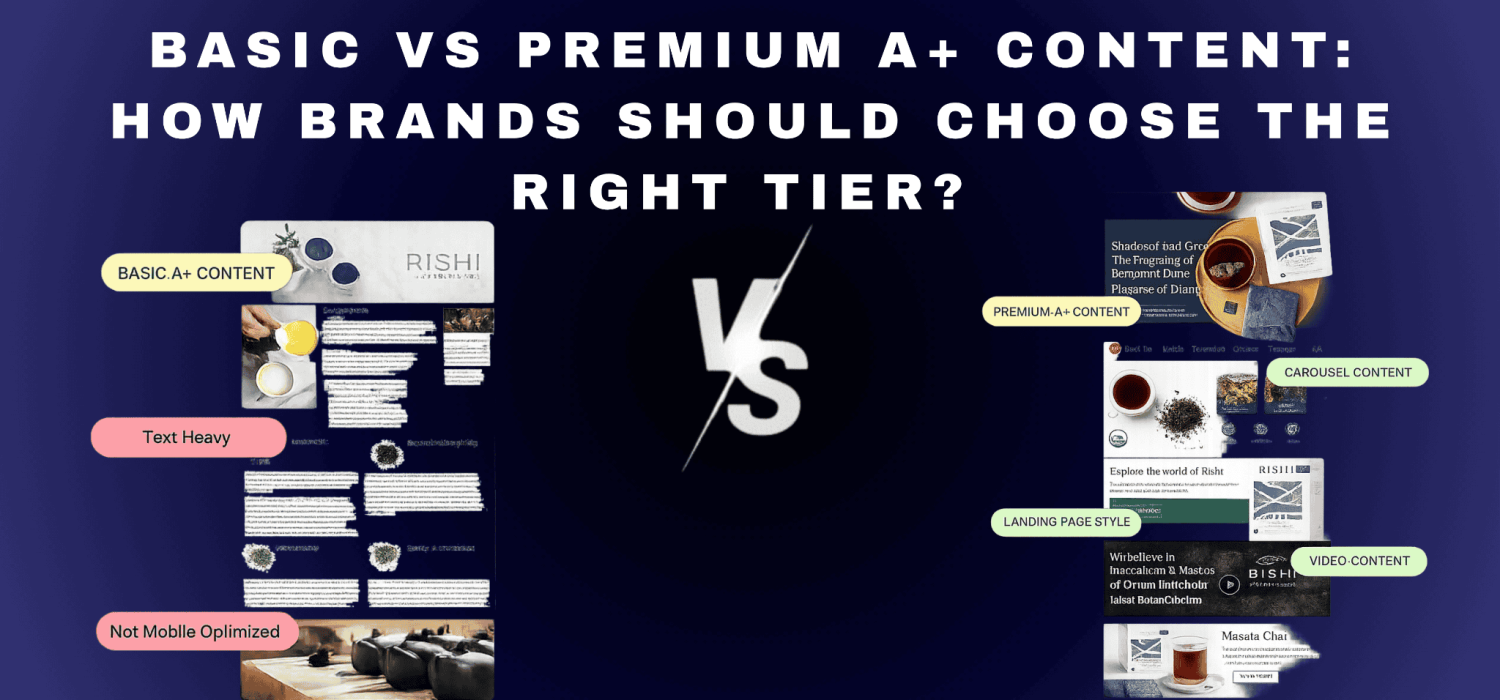
However, not every SKU needs the same level of content investment, and Amazon’s two A+ Content tiers sit at different points on that scale. While Basic A+ Content improves catalog-wide clarity at minimal cost, Premium A+ Content adds richer storytelling and differentiation on priority listings that justify the higher spend. The first step toward allocating that budget effectively is understanding what separates the two tiers.
Key Differences: Amazon Basic A+ and Premium A+ Content
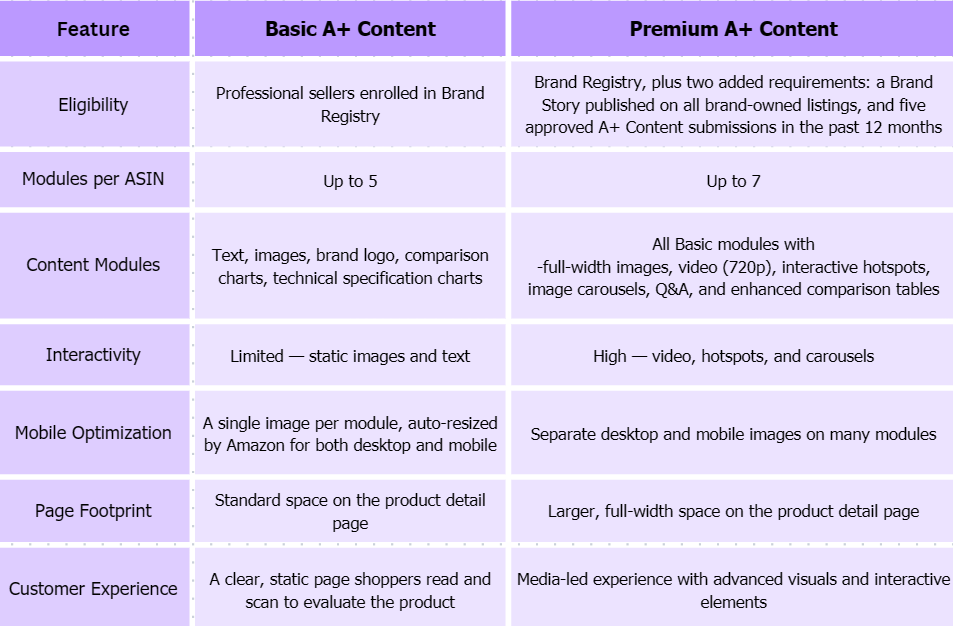
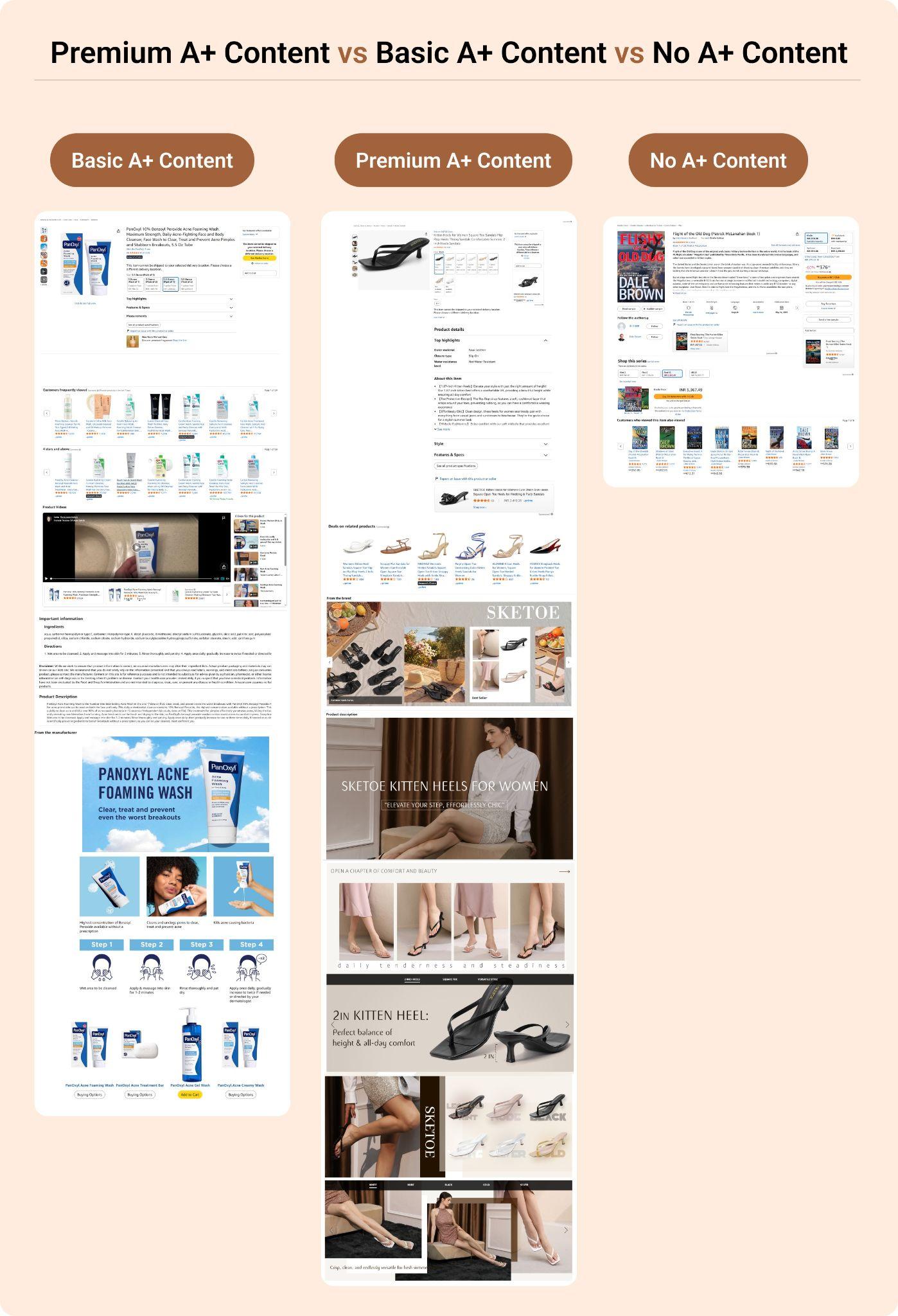
Standard (Basic) A+ and Premium A+ Content are managed through Amazon’s A+ Content Manager and share a common foundation: both require Brand Registry, replace the plain-text product description with modular image-and-text content, and aim to lift conversion.
They diverge on three aspects: access (who can use each tier), capability (what you can build), and customer experience (how the page feels to shoppers). The tables below compare the tiers across all three.
The matrix below shifts to the build level: the exact module types, counts, and image specifications available in each tier.
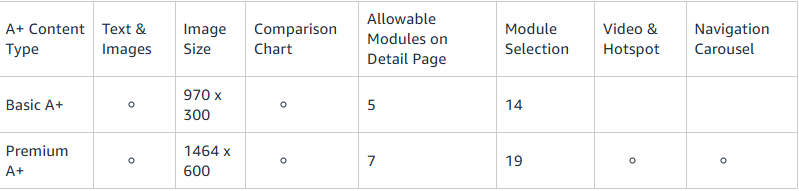 Source: Amazon
Pros and Cons: Basic A+ vs Premium A+ Content

Basic A+ Content
Advantages
- Any Brand-registered seller can publish it for free across the entire catalog immediately, with no eligibility criteria to meet.
- Basic A+ Content increases sales by up to 8%.
- Standard A+ Content delivers most of the conversion lift at a fraction of the production effort, since its static modules need no video or custom design.
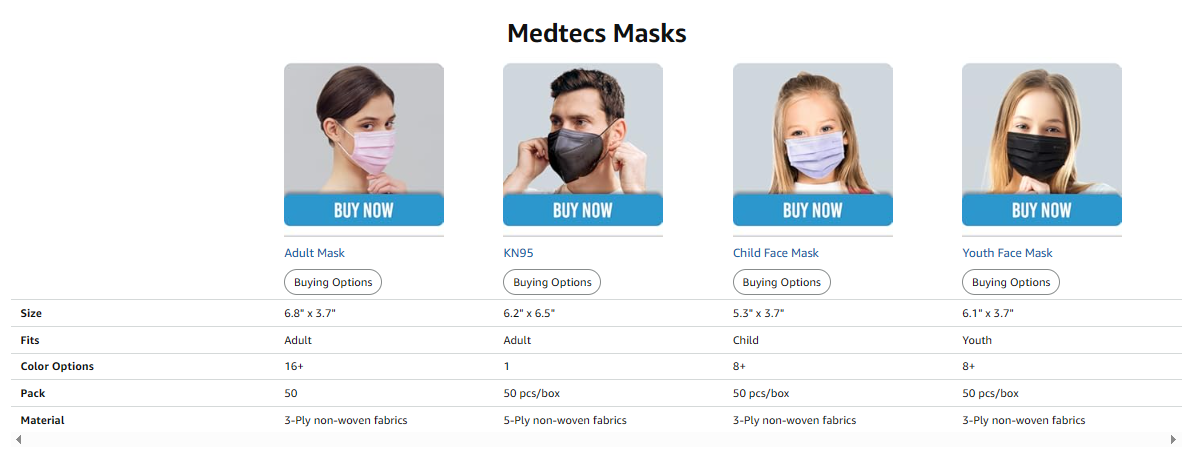
- The comparison chart, one of the highest-converting modules, comes at no extra cost and can cross-sell other products in the catalog.
Limitations
- Standard A+ modules reach only 970 pixels wide, so the content does not span the full detail page and leaves whitespace on each side.
- For feature-heavy or high-consideration products, static images and text cannot show the item in motion or resolve every question before purchase.
Premium A+ Content
Advantages
- The full-width canvas, video, and interactive modules produce a more polished page and a higher conversion ceiling of 20%.
- For complex or high-consideration products, video and interactive hotspots can demonstrate the item and resolve objections that static images cannot.
- Eligible sellers can access Premium at no extra fee from Amazon.
Limitations
- Contrary to the widespread claim that Amazon made Premium A+ accessible to all brand-registered sellers with no additional conditions, the requirements have not changed.Amazon Seller Central forum: A seller asks whether Premium A+ is now open to all brand-registered sellers.
 In response, an Amazon representative confirms the eligibility requirements have not been removed.

 In response, an Amazon representative confirms the eligibility requirements have not been removed.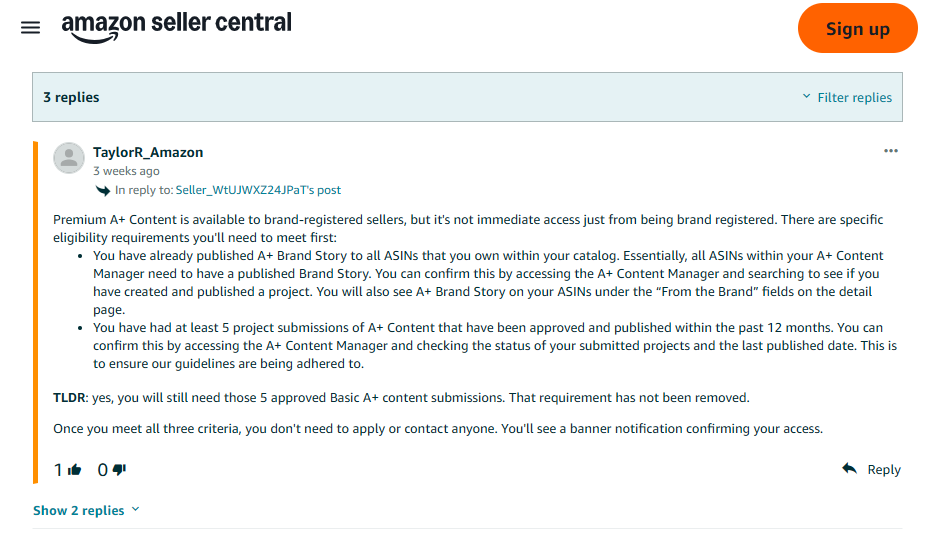
Source: Amazon
Therefore, Premium A+ does not serve as a starting point for brands; it first requires a Brand Story on every listing and five approved A+ submissions within 12 months.
- Premium A+ Content incurs high production costs, since video, custom graphics, and professional copywriting require significant time and budget.
- Strict character limits push the emphasis toward quality images and video rather than detailed text.
Factors Brands Must Consider Before Choosing an A+ Content Type
- Budget: Map the available budget to the level of creative production each SKU needs. Use standard copywriting, simple image edits, and specification grids for wider Basic A+ coverage, and allocate budget for Premium A+ Content to SKUs that need specialized copy, custom graphics, videos, interactive modules, and Amazon-ready visual assets.
- Product Complexity: Cover products with simple features, familiar use cases, or low explanation with Basic A+. Premium A+ Content is better suited for technical, high-consideration, or multi-feature products where videos, infographics, comparisons, or interactive elements help explain the value more clearly.
- CRO Objectives: When the goal is listing completeness and product clarity, Basic A+ Content can be enough. For goals such as reducing buyer hesitation, explaining differentiators, increasing add-to-cart rates, or improving conversion on high-traffic SKUs, Premium A+ Content is a stronger fit.
- Catalog Size: A small catalog of a few flagship products can justify Premium A+ Content, since the brand can allocate resources to each. A large catalog with hundreds of ASINs makes it impractical due to high cost and production time. Most brands at that scale run Basic A+ Content across the full catalog for baseline optimization and reserve Premium A+ Content for high-performing SKUs.
- Category Benchmarking: Standard A+ layouts are suitable in categories where competitors do not use rich media. Premium A+ becomes more relevant when competing listings use videos, interactive hotspots, enhanced comparison modules, and richer visual storytelling.
- Margin and Sales Potential: Choose Premium A+ Content only when the SKU has enough margin, traffic, or sales velocity to recover the additional spend on advanced content production.
The Framework: How to Choose the Right A+ Content Type for Your Brand
The right A+ Content tier varies from one product to the next. Some SKUs only need Basic A+ to improve clarity and close content gaps, while others may justify Premium A+ because the added visuals, interactivity, and storytelling can support stronger conversion.
A step-by-step rollout helps brands with a practical way to build A+ coverage first, then reserve Premium A+ Content for SKUs with stronger conversion potential.
The Five-Step Workflow
Step 1: Apply Brand Story across all SKUs to build a consistent brand identity and create cross-selling opportunities across related products.
Step 2: Apply Basic A+ Content across all SKUs to replace plain text with visuals, charts, grids, and modules that explain benefits, use cases, and specifications.
Step 3: Run a 60-day A/B test through Manage Your Experiments to see how each listing performs with enhanced content. Track conversion lift, compare results across SKUs, and use the data to prioritize products that are most likely to justify a Premium A+ Content upgrade.
Step 4: Review competitor listings to identify where Premium A+ Content has become the category norm. Prioritize SKUs where competing brands are already using videos, interactive hotspots, enhanced comparison modules, or richer visual storytelling.
Step 5: Upgrade the shortlisted SKUs to Premium A+ where performance data, margin, and competitor analysis justify the higher production cost.
Where Brands Go Wrong With Amazon A+ Content
- Keyword Stuffing in A+ Content: Forced keywords into A+ Content make it less useful for decision-making and ineffective at communicating the product’s real value. Use the space to highlight benefits, show use cases, compare product options, and address common buyer concerns.
- Low-Resolution Images: Blurry or poorly cropped visuals make the listing look less credible. Every image, chart, and infographic should be of high-quality, readable, and optimized for Amazon’s module dimensions.
- Not Optimizing for Mobile Shoppers: With mobile shoppers accounting for over 60% of Amazon traffic, dense graphics and small text can weaken the A+ experience. Preview every A+ layout on a phone before publishing to check readability, image cropping, and module flow.
- Repeating Standard Product Description: A+ Content replaces the plain-text descriptions, so it should not restate the same information in a visual format. Use it to add clarity, comparison, product USPs, and stronger product storytelling.
- Overusing Visuals without Structure: Too many videos, hotspots, graphics, and interactive modules can overload the listing, making it harder for shoppers to identify key benefits or specifications. Each visual should have a clear role: help buyers understand, compare, or decide.
The Operating Model: Choosing Between In-House and Amazon A+ Content Services
The decision depends on catalog size, content frequency, creative bandwidth, and the level of production each SKU requires. In-house teams offer stronger control over brand voice and product positioning, but A+ Content production often needs more than basic copy and design support.
- Build in-house when you have a dedicated content team with copywriters, designers, product marketers, and Amazon specialists. This works best for brands with frequent SKU launches, regular content testing, and enough internal capacity to manage copy, visuals, approvals, and updates without slowing other eCommerce priorities.
- Outsource to Amazon A+ Content Services when the catalog is large, the internal team is stretched, or Premium A+ requires custom graphics, infographics, video adaptation, comparison modules, and mobile-ready layouts. An external team can help brands scale Basic A+ Content faster, produce Premium A+ assets for priority SKUs, and keep content production moving without adding permanent creative overhead.
- Use a hybrid model when the strategy should remain internal, but execution requires external support. In-house teams can own positioning, SKU prioritization, and approvals, while an outsourcing partner handles copywriting, image editing, module design, video formatting, and Amazon submission support.
The Strategic Takeaway
The strongest A+ Content strategy does not rest on the most advanced modules. A winning strategy comes down to knowing which SKUs deserve more content investment and how that investment will be measured. Brands should audit A+ Content regularly, compare performance across SKUs, and update modules when customer questions, competitor benchmarks, or product positioning shifts. This discipline turns A+ Content from a one-time listing enhancement into a repeatable lever for conversion and catalog optimization.
 Author Bio : Hazel James is an eCommerce consultant at SAMM Data —a leading eCommerce growth agency offering product data management, eCommerce marketing, marketplace management, and branding & creative solutions. She works closely with 45+ brands to optimize their eCommerce operations and uncover new growth opportunities. Hazel excels at analyzing market trends, spotting emerging technologies, and implementing best practices, enabling businesses to maintain a competitive edge. With her expertise, she helps brands make data-driven decisions and streamline their operations, ensuring long-term growth and operational efficiency.