
Run several Claude Code agents at once, each on its own branch.
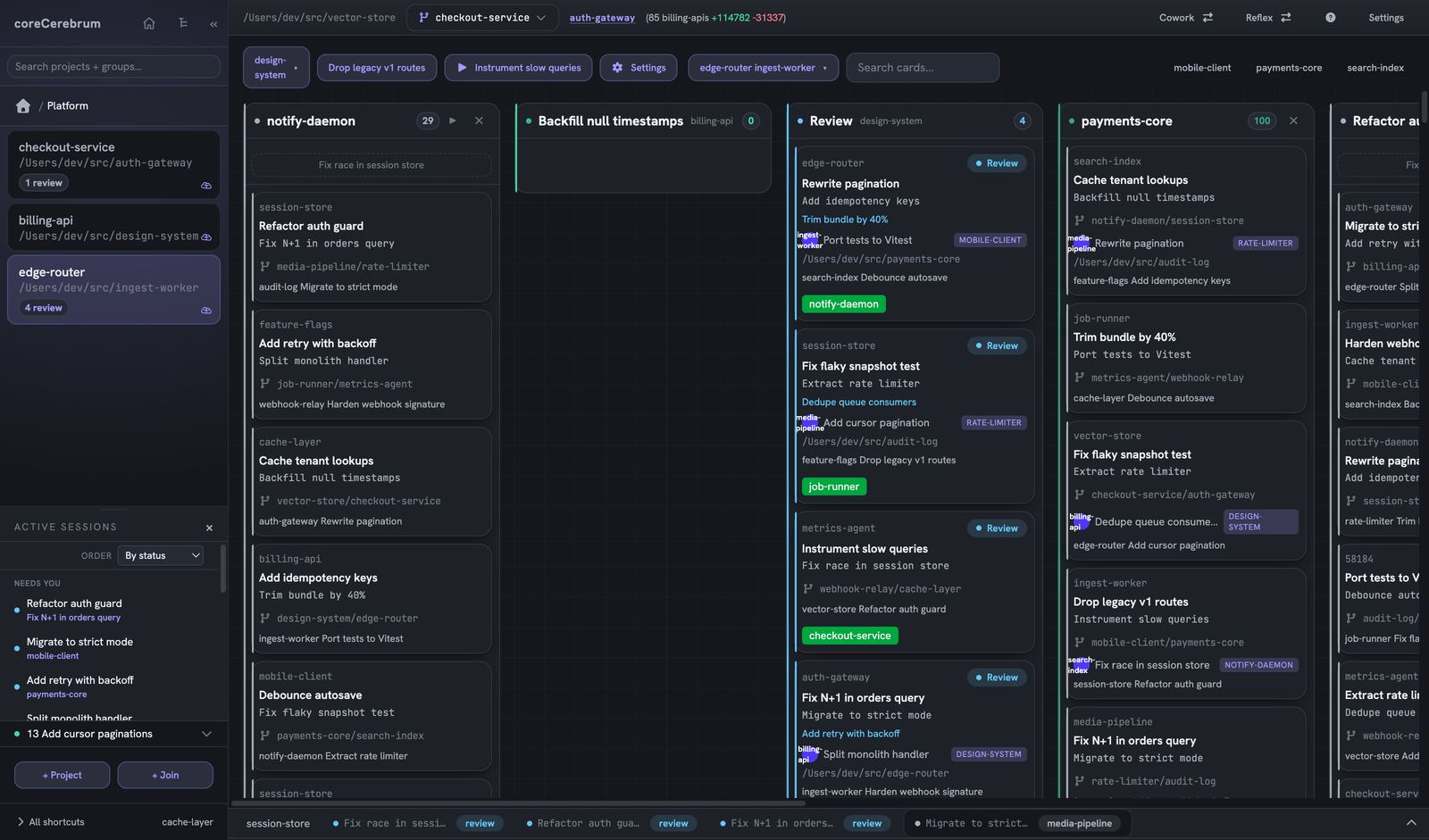
The board is the interface. Every card is a running agent, working its own branch while you watch the diff. Each card spawns a real Claude Code session in its own git worktree, on its own branch, with memory that survives the session and the teammate.
Simulation of the board. Real captures from a running install further down.
The ceiling is not the model. It is the session.
One window, one branch, one context that fills. The work serialises behind a single agent, and everything it worked out about your codebase, the conventions, the traps, the decision you spent an hour settling, dies when the window closes. Four things move that ceiling, and all four are mechanical rather than a better prompt.
A git worktree per agent
Each card spawns a Claude Code session in its own worktree on its own branch. Ten agents running at once produce ten diffs you can review separately, in the tool you already use to review diffs.
Memory that outlives the window
Decisions, conventions and gotchas are written to a store that survives the session and syncs to every teammate’s harness. Week two starts where week one ended, on any machine on the team.
The bill, per tool call
Token spend read from Claude Code’s per-turn transcript and attributed to individual tool calls. Across 1,618 sessions here, 98.2% of prompt tokens came from cache, and your own figure is on the board from the first week.
One harness, every teammate
24 skills, 22 commands, 5 review agents and 10 hooks, installed identically for
everyone, with a guard layer that refuses rm -rf /, force-push to main and
hardcoded secrets before the model can run them.
38 billion prompt tokens. 13% of them billed.
Whatever the seat costs, the question is what happens to your Claude bill, and most of that bill is prompt tokens you have already paid for once. Over 1,618 sessions on one machine, 98.2% of ours were served from cache. The same work billed at full input price would have cost 7.6 times more. coreCerebrum reads Claude Code’s own per-turn transcript and attributes real tokens to individual tool calls, so that number is visible to you from the first week rather than arriving on an invoice.
Measured on one machine across 1,618 Claude Code sessions and 105,724 assistant turns, an average of 65 turns and 23.5M prompt tokens per session. Priced at published cache multipliers: reads at 0.1x base input, writes at 2x for one-hour TTL and 1.25x for five-minute. The saving holds between 86.6% and 88.0% across every TTL mix, which is why the multiple is quoted at 7.6 rather than rounded up. This is one installation doing our kind of work; yours will differ, and your own figure is on your board from week one.
Where the waste goes
Three things drive a prompt bill up: re-reading files a session has already read, re-deriving decisions that were settled last week, and hauling context that stopped being relevant twenty tool calls ago. All three are invisible on a board that reports only status, which is why the harness watches for each of them.
A board that reports only status shows you the top four lines. The harness reports the other three.
Real output of /cost across the 1,618 sessions above.
cache_read is the line that matters: 37.3 billion tokens the model saw
and nobody paid full price for.
Re-read detection
The harness tracks what a session has already read and estimates the cost before it reads it again.
Memory recall
Past decisions and gotchas surface on the prompt that needs them, so a settled question is answered from the record instead of re-derived.
Per-tool attribution
Real usage read from the per-turn transcript Claude Code actually sends, so the number is the tokens that went over the wire.
Four parts, one machine.
Parallel agent sessions
Every card runs a real Claude Code session, many at once, each with its own context, its own git worktree and its own branch.
Worktree isolation
One git worktree per card, on its own branch. Agents cannot collide, and nothing lands on main by accident.
Persistent team memory
Decisions, conventions and gotchas outlive the session, and sync to the team rather than dying in one transcript.
Session control
Watch the diff, read the log, stop it, or take the wheel. The board is a control surface: start, stop, redirect and review each agent from the card.
Isolation is the feature.
Parallelism without isolation is just a faster way to create merge conflicts. Every session gets a real worktree on a real branch, so ten agents working at once produce ten reviewable diffs, not one tangled working tree.
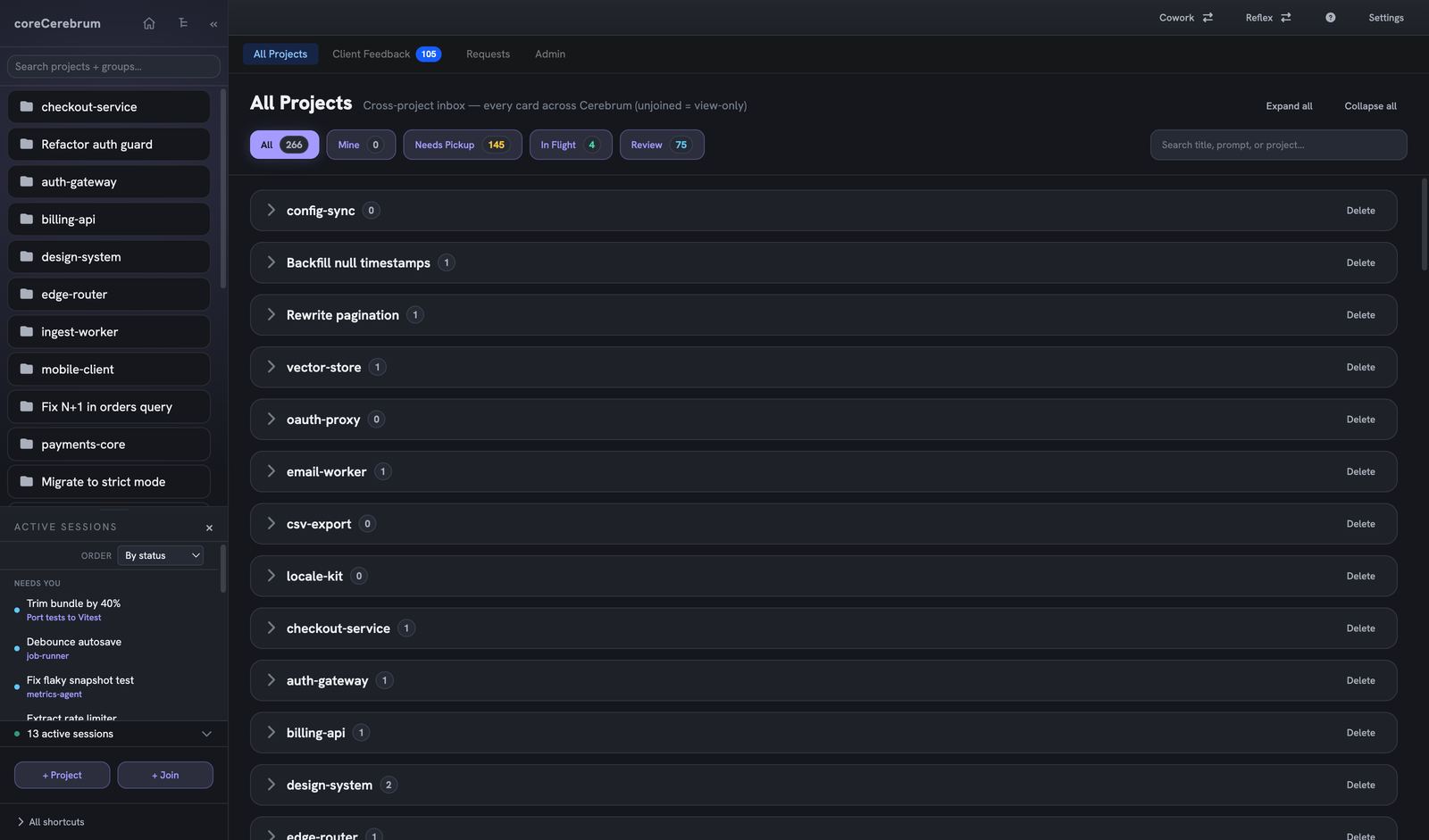
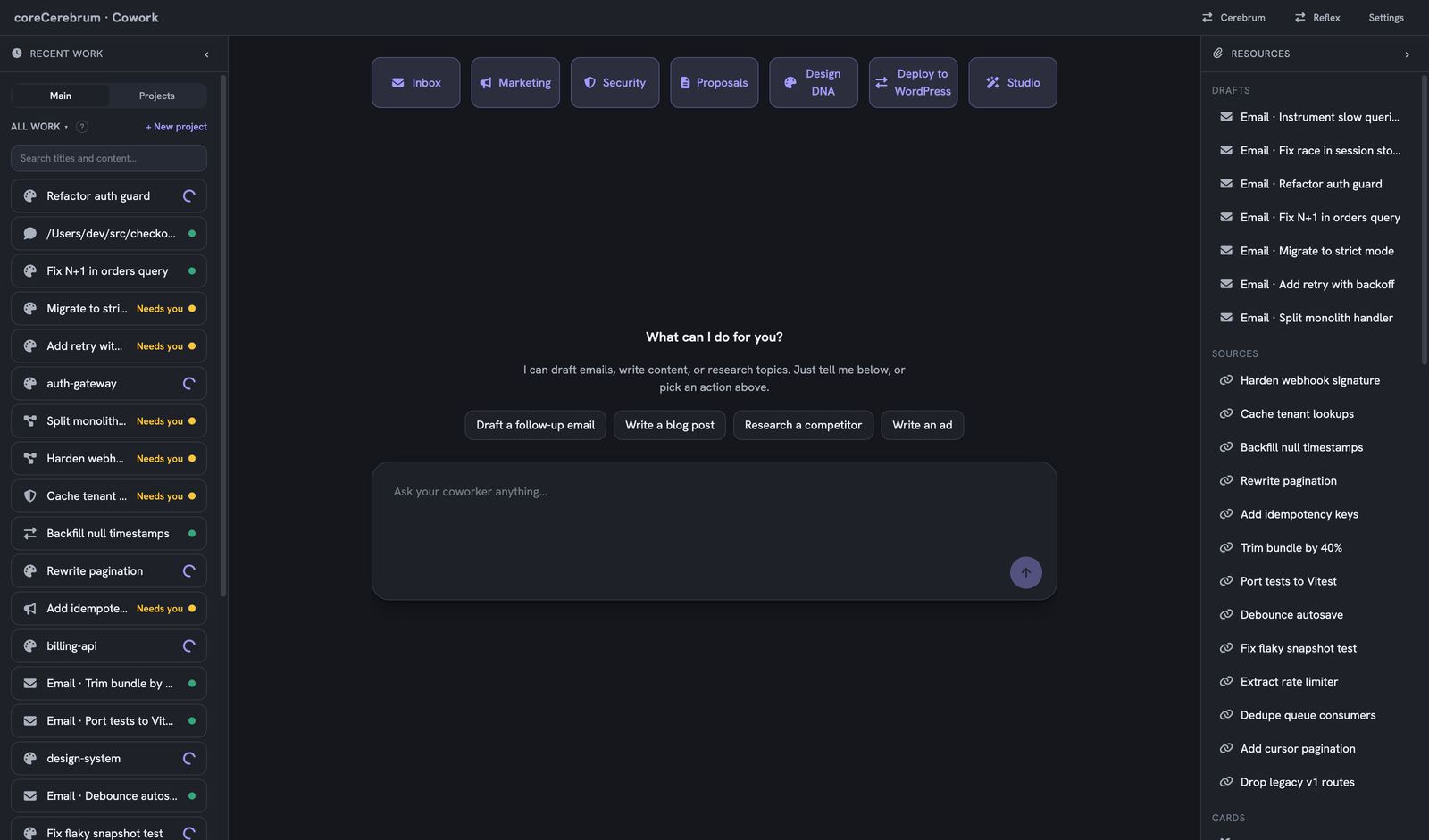
These are real captures from a running install.
Captured from a running install. Card, project and session names are pseudonymized; the interface, the counts and the states are real.
Thirty minutes, screen shared, on your code rather than a sample project. If it does not fit the way your team already works, we would rather tell you that than sell you a seat.
Agents are only as good as the harness around them.
One shared configuration reaches every teammate identically: skills, commands, review agents, and a guard layer that refuses the operations you never want an agent to run.
Destructive operations are denied outright
rm -rf /, force-push to main, DROP TABLE, chmod 777, pipe-to-shell, and hardcoded secrets in writes.
The bug log opens before the file does
Known failures and do-not-repeat entries for the exact file being edited, surfaced before the edit, plus a warning at three edits to one file.
Token spend attributed per tool
Read from the authoritative per-turn transcript, so the number is the tokens that actually went over the wire.
Running agents in parallel is table stakes now.
Several tools do that, and some of them are free. The difference is what survives when the session ends, and whether anyone can tell you what the work cost.
| Capability | Typical agent board | coreCerebrum |
|---|---|---|
| parallel sessions | Yes | Yes |
| worktree isolation | Yes | Yes |
| memory across sessions | Not offered | Persistent |
| memory across the team | Not offered | Synced |
| token and cost accounting | Not offered | Per tool, per turn |
| shared skills and commands | Not offered | 24 and 22 |
| destructive-operation guard | Not offered | Hard deny |
| docs sync | Not offered | Included |
"Typical agent board" reflects the published feature and pricing pages of the parallel-agent tools we compared in August 2026. Their pages name parallel agents, workspaces, cloud hours and collaboration. None of them names persistent memory, team memory, cost accounting, or a guard layer.
Stop waiting on one agent.
Licensed per seat, quoted for your team. coreCerebrum runs every engagement we take, which is the only reason we are willing to put it in front of your team.